Friday, 8 November 2013

Prague Photos October 2013


Our walking tour of Prague, with guide Eva.


Charles Bridge early in a misty morning

 St Vitus cathedral at Prague castle. The cathedral was started in 1340 and finally completed in 1929!


Detail from a statue on the Charles Bridge


 St George's Basilica, Prague castle. Built in the eleventh century.
Detail from the outside, St Vitus Cathedral, Prague castle 

New synagogue, Prague. Built in 1240


Prague view across to the Charles Bridge. 
 
Tyn church from the central square in Prague old town 


The view from our hotel in Prague.

Prague view across to the Charles Bridge. 


Sibiu and Brasov,Romania, photos October 2013

After Budapest we travelled by train to Romania


Sibiu city wall built in the 14th century


Brasov Square in the snow 
 
Sibiu street in the old town

An old manuscript in the First Romanian School Museum, Brasov.
The Black Church in Brasov


Outside the Brasov city wall
 
 Our breakfast restaurant in Brasov

Modern Brasov, well outside the old city walls.
 
 
The inner courtyard of the fortified church at Prejmer.
 
The fortified church at Prejmer (outside view). 
 

Budapest Photos October 2013

We spent a week in Budapest in early October 2013

 
Matthias church in the Castle district in Buda.
 
Mary Magdalene Tower (C13) in the Castle district.
 
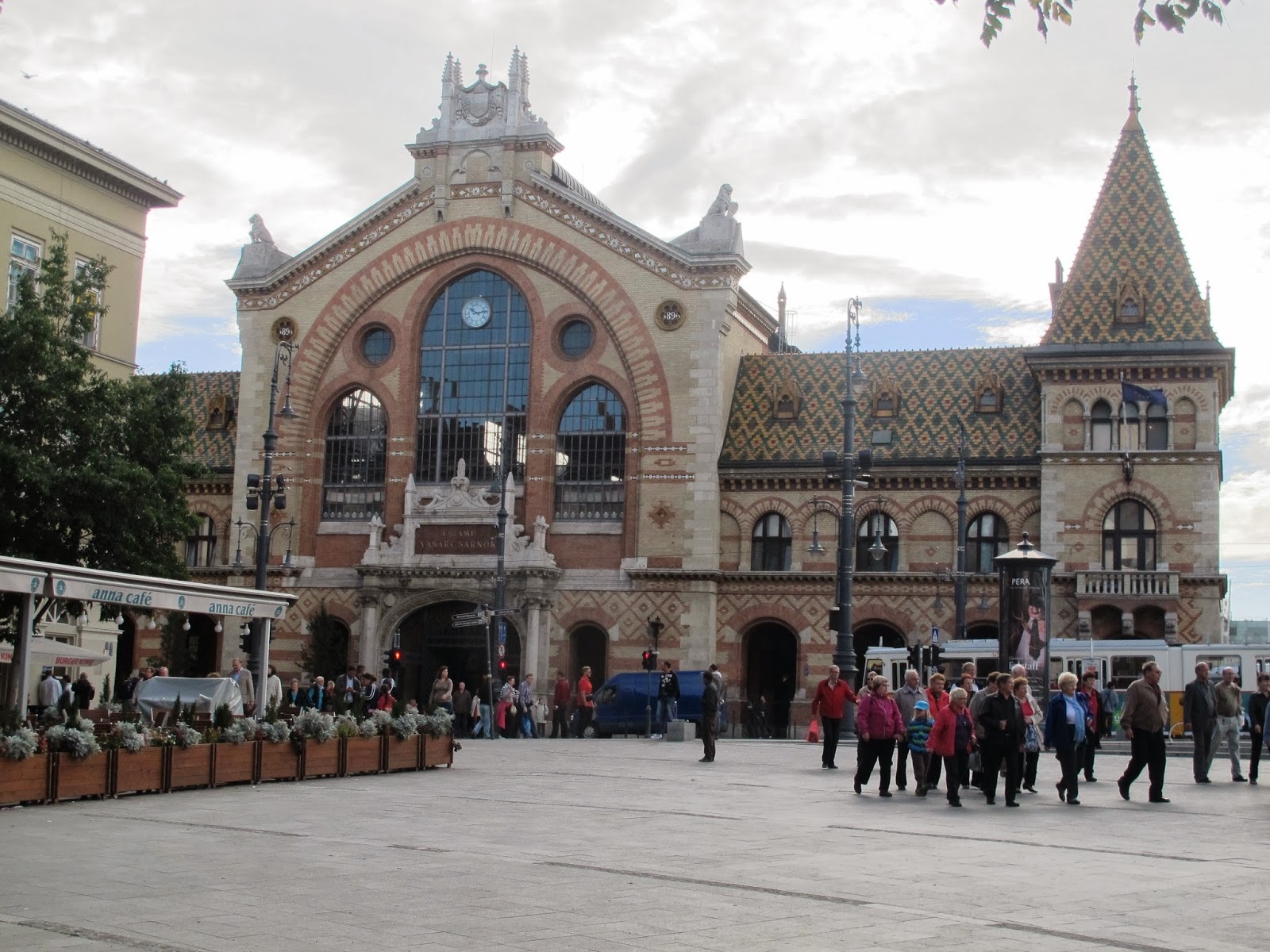
City Market building. Five minutes walk from our apartment.

Palace Building (The Castle) in Buda.


Our apartment building. The Danube river is at the end of the street.
 

House in Buda. Attic windows in Romania and Hungary have these unusual shapes. 
Parliament Buildings. There are lots of leafy small parks in Budapest.
Szechenyi Bridge across the Danube. 
 
 Parliament Buildings from the Palace Hill
 
The Danube is indeed blue (providing the sky is blue too!). 
 
Autumn trees in Budapest.


A salute for the Children's Railway


A week in Holland in October 2013

Most of our time in Holland was spent visiting Lyn's friends and relations


Lyn with bikes on a canal bridge in Amsterdam.


Amsterdam is often called the Venice of the North. We took a walk along the canals.


 Hannie and Marcel's home in Van Eeghen Street, Amsterdam.
 
 With Hannie and Marcel in Amsterdam.
  

Lyn with our friends Botsje and Andre in Kubaard.


 The church in Kubaard where Lyn's father was once a predikant (minister)
 

 The manse where Lyn was born in Kubaard
 

 Botsje's 200 year old home in Doniaweg, Damwoude, Friesland.
 
 Old friends: Botsje and Lyn
 

 Cousins Sjaak and Connie with Lyn in St Maartensdijk.

 The church in St Maartensdijk where Lyn's Grandfather was the minister for many years.
 

 Lyn with Tante Annie in St Maartensdijk.

Monday, 28 October 2013

Rail Travel in Europe


Rail Travel in Europe


Lyn and I have just returned from a month (September/October 2013) in Europe, travelling between cities by rail. We booked all the trips directly with European websites and found this much cheaper than using Eurail passes or their equivalents, or by using specialist travel agents in Australasia, which appear to charge two or three times what we actually paid for the rail travel.
 
Our German ICE train arrives at the Station

Some helpful advice:

·        The best Internet site to get an overall idea of what might be available is The Man in Seat Sixty-one ( www.seat61.com/). This website contains all you could ever want to know about the type of trains available and gives some ideas on pricing. Use this as an online guide to plan your trip.
·         The German DB rail site (www.bahn.de/i/view/overseas/en/index.shtml provides a comprehensive train schedule with all of Europe’s train trips . Any trains you book on this site must arrive or depart from Germany (or are totally within Germany), but you can seek out individual travel trains and times between any European cities. We also had an up-to-date copy of Thomas Cooks’ Rail Timetables, but this wasn’t really needed.
·         We used the German (DB) rail site, the Hungarian  (MAV) site and the Romanian (CFR) Internet sites to book and pay for our tickets. You need to register as a customer the first time you use each site. The earlier bookings are made, the cheaper the prices. For example, bookings on the DB Rail site open three months before travel, which is when prices are lowest. We knew what days we wanted to travel because we pre-booked our accommodation, so this worked well for us. Because tickets much closer to the day of travel are more expensive, a rail pass may be more worthwhile if you want to keep your travel dates flexible
·         DB Bahn. This is the most client-friendly site. The prices are in Euros, just choose your train and go. One oddity is that you can book the train three months in advance, but actual seat bookings (which cost four euros each) can only be made two months in advance, so you will need to make seat bookings at a later stage if you want them, either via the Internet or after you arrive in Germany. A further aberration is that any seat booking that crosses an international border cannot be made over the Internet, and must be phoned through before you travel or made once you arrive in Europe. However, we managed this without any real problems, despite requiring last minute changes after floods damaged the Berlin to Amsterdam rail line. 

·         MAV (Hungarian rail). We made three bookings over this website for trains that either left or arrived in Budapest.  The prices are in Euros. Tickets are not sent over the Internet, just coded emails, which are then used in special ticket machines at major Hungarian rail stations to get printed tickets. We had absolutely no problems in using these at Budapest.
The MAV website (elvira.mav-start.hu/elvira.dll) is a bit cumbersome to use, but it’s worth persevering with because ticket prices are very reasonable. Some tickets are available three months prior to travel, while others can only be purchased two months in advance. The MAV website will make it clear when tickets are available. In addition, when travelling on some routes, only certain types of tickets can be purchased in advance. We wanted a sleeping compartment to travel on the night train from Brasov (Romania) to Budapest but only second class berths were available. To get our own compartment, we booked and paid for a berth for our daughter as well (who was staying in New Zealand!) - it was much cheaper to book a 3-person compartment (total cost 147 euros) using the MAV website than purchasing a 2-person berth from a New Zealand travel website. 


Waiting for our train in Sibiu, Romania


·      Romanian (CFR) website www.cfrcalatori.ro/270 We used this site to book seats for the second class train from Sibiu to Brasov in Romania. The tickets are priced in Romanian Leu and are available just one month in advance, but are cheaper on the net than they would have been on the day of travel. Purchasing the tickets in advance overcame potential language difficulties in Romania.
·        We didn't use the Dutch rail site in the Netherland; instead, we purchased OV-chipkaart travel cards. We loaded these up with Euros at Amsterdam Centraal station upon arrival in Holland. These cards can be used for internal rail travel in Holland (we visited Lyn’s relatives and friends in both the north and the south of Holland during our short visit there) and also on trams in Amsterdam. The only glitch was that in one railway station (but not others!) there were separate machines for logging on and logging off the system. When attempting to “log on” as we left Leeuwarden, we used the “log off” machine by mistake. This cost both of us an extra 10 euros because the train conductor required us to "log on" again at the next station. Chatting with fellow (Dutch) passengers, we found out that others had experienced similar problems at this station.


Our train travel throughout Europe was always comfortable and the carriages and cabins were clean. On some trips we met fellow travellers, on others we had a whole compartment, or even a whole carriage, to ourselves. We took our own lunches, water, and wine so we didn’t need to sample food from the restaurant cars.

Toilets were clean, with the unlikely exception being some trains in Holland. Sometimes toilet paper ran out on a big trip, so make sure you have some of your own.

Passports were checked only on the Romanian – Hungarian border. No hassles there with our NZ passports, but the passport control does delay the trains. 

The tickets we purchased, including seat reservations, with the price in $NZ per person were:           

Budapest to Sibiu (1st Class)                              $110                (10 hours)
Sibiu to Brasov (2nd Class)                                   $14                 (2 ½ hours)
Brasov to Budapest (2nd Class Sleeper)              $125                (12 hours)
Budapest to Prague (1st Class)                              $59                 (7 hours)
Prague to Berlin (2nd Class)                                  $53                 (6 ½ hours)
Berlin to Amsterdam (1st Class)                          $124                (8 hours)

Sunday, 1 September 2013

Two Weeks in Vietnam - March 2013


We had heard that crossing roads in Hanoi Vietnam could be a dangerous exercise for the uninitiated, but in practice it wasn't so bad. While the busy road traffic takes little heed of such niceties as pedestrian crossings, and even traffic lights at times, the general advice to just walk across the road at a steady pace and this worked well.

Nearly all the traffic is composed of motor-bikes.There are a reported 4 million of them in Hanoi alone). As a collision would most likely damage the bike rider as much as the pedestrian, road crossing is relatively safe.

Vietnamese law also makes helmets compulsory which has led to most riders wearing helmets in name only because they are much cheaper. They would offer very little head protection in a crash).

We had arrived in Hanoi from Laos to stay at our Trip Advisor recommended Hotel Essence in old Hanoi. It was a great little hotel, with an excellent restaurant and friendly helpful staff.

Walking out the hotel's front door took us directly out on to a busy street in an old part of the city, yet our room was nice and quiet. Our days in Hanoi were spent walking the streets, visiting museums, stopping at Ho Chi Minh's tomb where the long queue deterred us from entering but provided great photo opportunities, and getting lost a few times in the narrow streets of old Hanoi.

We especially enjoyed the women's museum, where we were surrounded by hordes of noisy school-children in the outside patio, and also the Hanoi Fine Arts Museum, with, among a wide range of works, paintings of Uncle Ho in many different settings.

We also took a day tour out into the countryside, to view small towns, rice paddies, limestone mountains and to travel through caves on dinghys rowed by women using their feet, instead of hands, on the oars. Whatever we did during the day, it was accompanied by some very nice Vietnamese food, at very nice prices!

 
Hanoi was much busier than Siem Reap in Cambodia or Luang Prabang in Laos where we had come from. More people, more tourists (and of course more motor-bikes). But the change to a more rapid pace was a good contrast to the more laid-back travelling life we had been experiencing.

Incidentally, it's a long way from Hanoi's airport to the city, so take advantage of transfer offers from your hotel. And also be aware that in Vietnamese airports they do check that you have airline receipts for all your luggage before you can leave the airport.

After six days in Hanoi we flew to Danang before transferring by car to the old imperial capital of Hue (runway work at Hue airport stopped a direct flight), to stay for 3 nights in the Orchid Hotel.

We chose a "romantic room" on the seventh floor, where we had a good view of the town and the Pearl River (and the room's resident goldfish probably had had a good view of romantic proceedings inside the room over time). Life in Hue was quieter than Hanoi, although the ever-present motor-bikes still ruled the streets.

The highlight of any visit to Hue would be the Citadel, the huge old walled compound where Vietnam's emperors once lived, that also played an important part during what locals called the American war. The large Vietnamese flag flying over the entrance can be seen many kilometres away. Much of the Citadel is still in semi-ruins, but a rebuilding campaign is underway.


We finished our Vietnamese trip about three hours away in the beautiful tourist town of Hoi An. For the first time on our travels we changed from a small hotel to a quite large one (the Hoi An Pacific Hotel) which looked as though it had been built for Russian tourists, many of whom still visit Vietnam.

The hotel was more impersonal than others we had stayed at, but had a nice pool to cool down during the hot afternoons and was within walking distance of the old town. Hoi An is full of restaurants, shops selling clothes and souvenirs and also has several historic houses and temples to visit.

At night time the coloured lanterns in the streets make them a lovely place to visit.  It does pay to pick your time to travel here, as the whole town can be flooded during the wet season, with boats travelling in the streets.

 
Time was pressing, so we didn't travel on southwards to Ho Chi Minh city and the Mekong Delta, but instead flew back to Hanoi to catch our flight back home.

More photos from our travels can be seen in photographic blogs at this blog site.

Monday, 8 July 2013

An Upbeat Outward Bound Adventure


This was a column I recently wrote for  GrownUps at
http://www.grownups.co.nz/read/lifestyle/hobbies/edi-lyn-potter-upbeat-outward-bound


When my sister Margreet emailed me her Outward Bound journal, I found it so inspiring that I asked her if I could share some excerpts with GrownUps.

My brother-in-law Neil has early Parkinson's. Although it can be a debilitating disease with an uncertain future, Neil and Margreet are staying positive, making the most of what Neil can do now and living life to the max.

This year they were accepted for the Upbeat Outward Bound course, an annual event for people with early Parkinson's. Participants can either go independently or with a partner/carer. The course involves a wide range of challenging activities in a safe and supportive environment.

Unfortunately, Neil took ill shortly before the course began and was unable to go, but he persuaded Margreet to go on her own - his turn will come next year.

Sunday


Nine "parkies", three carers, and one Parkinson's field officer (ranging in age from 45–67) met at the Picton Ferry terminal. The boat trip to Anikiwa took 40 minutes. On arrival the group were greeted with a pōwhiri.

After settling in, instructors Ben, Dave, and Chee took the group for a gentle jog around the grounds. Then it was some PT ("physical torture") by the water and full immersion in the bay (fully clothed and holding hands). Many wondered what they had let themselves in for!

Monday


This was the day of the high ropes course. Margreet knew this would be her biggest challenge. Would she be up to it? For those who had to cope with Parkinson's symptoms, it would be even harder.
Outward Bound Climbing Wall
"It was so scary going into the High Ropes area and seeing what we needed to do 10 metres above the ground: a climbing wall, a balance beam, climbing over moving tyres, jumping between two platforms. The best part was the flying fox at the end."

The instructors showed endless patience but insisted that everyone go around the course. Everybody did it and all were very proud of what they had achieved.

Margreet is a trained massage therapist and was able to help relieve some sore necks and tired muscles at the end of the day.

Tuesday


Out in the Sailing Cutter for an overnight stay in Torea Bay. A few of the participants opted to sleep out under a fly on the bank above the beach. Although it was warm and cozy, Margreet began to ache from head to toe from the uncomfortable sleeping mats and ventured back to the bunk house. She was disappointed but it was the only challenge she did not complete.

Wednesday


A full day on a boat. The wind meant that everyone could have a go at taking the helm. They learnt to jibe (with the wind) and tack (against the wind) and goose wing the sails.

"It was amazing to see dolphins swimming alongside us, also seals, shearwaters and gannets."

Once back at Anikiwa, they cleaned the boat, anchored the cutter to a buoy, and swam back!

Hot showers and then another great dinner: stew, rice, and stir-fried veg, followed by spiced apple shortcake and goody-goody-gumdrop ice cream.

That evening the team prepared a dance performance based on their boating experience and put on a show for their instructors.
Outward Bound Sailing Group

Thursday


Time for some time alone to reflect on what had been gained from the Outward Bound experience and to enjoy the beauty and serenity of the setting.

In the afternoon, kayaking and a three-hour hike on the Queen Charlotte track.

"It was great to see Pied Shags, Grey Shags and Spotted Shags and yes by the time we got the boats safely cleaned up and away we were all shagged!!!"

Friday


A light breakfast was followed by a 5.5 km run and a jump off the wharf into the ocean.

After clean up, the group planted a tree together. Certificates and badges were handed out and then it was a 40-minute trip back to Anikawa by truck to say final farewells.

"All in all it was a wonderful experience. What a gutsy group of people our Parkinson's participants were. Despite dealing with specific symptoms and needs relating to their condition, they were all without exception up to taking up all the challenges laid down for them. With gentle encouragement and support from our three amazing instructors we all came away with a sense of empowerment and achievement. We all realized how important it is to keep stretching to the future. Having things to reach for keeps you in life."
Outward Bound Finish

Margreet's diary concludes with a quote from Mark Twain:


"Twenty years from now you will be more disappointed by the things you didn't do than the things you did do. So throw off the bowlines. Sail away from the safe harbour. Catch the trade winds in your sails. Explore, Dream, Discover."

To find out more about this adventure and how to apply, click here