Friday, 17 May 2013


Eating Out in Siem Reap
As Siem Reap is a tourist destination there are a great many restaurants so we were spoilt for choice. During our short stay we ate breakfast and lunch at our hotel at night but ventured out in the free tuktuk and driver they provided to sample the food in three local restaurants. The first was Sugar Palm
Sugar Palm
Sugar Palm is housed in a large traditional two storey wooden building with very high ceilings. It is owned by Bruce and (Cambodian born) Kethana Dunnet who moved to Siem Reap from New Zealand and serves traditional Khmer Food. When we arrived it was very crowded so obviously a popular place to dine. We would have loved to sit outside on the upstairs terrace but all the seats were taken.
It was disappointing that our waiter was somewhat offhand and neither of us felt that our meal was particularly memorable. My main, a vegetarian noodle dish was just a homely lukewarm bowl of fried noodles, not the steaming hot fragrant dish I had hoped for.
When I saw Cambodian's national dish "Amok" (a coconut curry steamed in banana leaves) being served decoratively in coconut shells to diners at the next table I realised that this would have been a much better choice. Especially when I discovered afterwards that Gordon Ramsay had chosen Sugar Palm to sample this Cambodian dish as part of his South East Asian Great Escapes TV series. What a shame I hadn't done my homework beforehand and chosen this.
Touich Restaurant
Our trusty tuktuk driver, Mr Sopheach, drove us to this restaurant. Towards the end of the journey there were so many potholes and bumps in the road that we were thoroughly shaken around. On arrival he apologised profusely. Actually I'd found it rather exhilarating taking a ride on the wild side. Apparently in the monsoon season the conditions are even worse and he would not have attempted it, but the restaurant can send out a 1964 Jeep to collect you.
Touich is a small restaurant run buy a large extended Cambodian Family and serves traditional Khmer cuisine. We had booked in advance to be sure of a table. The setting, with its tropical greenery and soft lighting was romantic.
There were a few mosquitoes hovering around but a mosquito coil was soon put under our table and from then on they kept their distance.
The young wait staff, all family members, was friendly and attentive. And the food was delicious. Especially the whole sand grilled red snapper. It had been stuffed with herbs including lemongrass, encrusted in salt, and then wrapped in a banana leaf before baking in an underground oven.
When serving the waitress split the fish in half so it was easy to pick the flesh away from the bones. It was cooked to perfection, tender and juicy with a hint of lemongrass.
Cuisine Wat Damnak
We had planned to dine at another restaurant but when we arrived at the address we found it was no longer there. Out tuktuk driver suggested that we try our luck at Cuisine Wat Damnak which was close by. Fortunately they had a spare table for us. It turned out to be an excellent choice and a unique experience.
The French chef, Joannes Riviere has lived in Cambodia for 10 years and is very familiar with traditional Khmer cooking which he has given them a modern twist. To go there is a culinary adventure. All their food is fresh and sourced locally. The menu changes week by week in harmony with the seasons.
The chef's wife explained that there were two degustation menus (which mean that you don't choose your own dishes, you eat what is put in from of you. Did we want to do this? We took a look at the menu and it all sounded so exotic and intriguing that we decided to give it a go.
There were two choices: one was US $19 for 5 courses and one US $26 for 6 courses. We settled for the first. (The prices look incredibly low, but this was one of the most expensive meals we had on our trip!).
The amuse bouche was followed by a ripe and green papaya salad with Chhlang fish and wild betel leaf. Next a barbecued pork stew in game style with wild sour leaf, holy basil and water celery and bowls of rice. This was followed by honey roasted free range chicken breast with water mimosa, fire ants and prahok relish.
This last dish would be my biggest challenge. I never eat insects, these fire ants sounded more gruesome than huhu bugs. To my relief they had been mashed into the relish and were invisible.
The dessert was toasted coconut mousse and sorbet with turmeric braised pineapple.
It had been an amazing meal. Yet another example of how you can eat like a king in many parts of Asia for a remarkably small amount of money.
This article was written for my regular column in GrownUps
Angkor Temple Hopping
We travelled to Siem Reap in Cambodia to explore the ancient Angkor temples, one of the world’s greatest heritage sites. On previous journeys we had seen the ancient monument of Borobudur, the Inca ruins of Machu Picchu and many of the old cathedrals of Europe and we weren’t too sure how they would compare. But Angkor certainly more than lived up to its reputation.
The Angkor temples are near the Cambodian town or Siem Reap, and the large number or temple sites occupy a large land area. To see them all would have taken at least two weeks. We had only four days there. So before we left Auckland we had narrowed it down to the temples we’d most like to visit, and how we’d travel between the temples, as they can be several kilometres apart. We used our local library which had several guidebooks on the area, including Dawn Rooney’s Angkor guide.
From New Zealand we flew directly to Siem Reap with Malaysia Airlines, with a three hour wait at Kuala Lumpur airport, thus avoiding a Phnom Penh stopover.
Our first task was to purchase our Angkor pass (we got a 3 day pass for $US40 each) from the ticket booth in town. We needed to both appear in person to be photographed, and our electronic images formed part of the tickets. Our Angkor passes would be checked before entering each site. As the 3 day tickets could be used from 5pm on the day before they actually started, our tuktuk driver then took us to Angkor Wat, the closest (5km from Siem Reap) and largest, temple for a brief look at what we would see the next morning.
Angkor Wat, built 900 years ago, is the best preserved temple. The central temple, on three levels, covers 9 hectares. We spent about four hours there after a dawn start on our first morning. There were quite a few other tourists, but the size of the temple soon spread everyone out.
In the evening, a main attraction for tourists is to scramble up a nearby temple hill to watch the sun set over Angkor Wat. We avoided the crowds and wandered instead through the nearby Banyon temple almost on our own. This tranquility was a great contrast to the hordes, along with buses and elephants, on this site earlier in the day.
We chatted with our tuktuk driver and agreed on another early start the next morning, this time at the man-made lake of Srah Srang. We were the only tourists looking out over the lake to watch the sun rise, along with few local kids there, hassling us for money which was unusual in Siem Reap.
After we’d watched the sun’s orange globe appear from behind the clouds we walked through the nearby temple of Banteay Kdei to arrive at the overgrown Ta Prohm temple, featured in the Temple of Doom movie. This temple was rediscovered by the French in 1947 and large numbers of trees still grow through the ruins creating an eery jungle like atmosphere.
To return many of these temples to their former glory a massive reconstruction effort is still on the way in many of these temples, with a great deal of overseas expertise and financial assistance as well as local knowledge and labour. It’s fascinating to see how huge piles of temple rubble are being reassembled and broken sculptures mended or replaced.
On our last day of temple hopping we travelled to the small temple of Banteay Srei, some 30 Km from Siem Reap. While many guide books indicate that the best way to get there is by car, we had a lovely trip travelling in the open air in our tuktuk and felt a little smug as we passed small tour groups of perspiring cyclists. The road to Banteay Srei is fully sealed, and passes through many small villages in the otherwise open Cambodian countryside.
Banteay Srei was crowded with Japanese tour parties taking snapshots of each other striking poses beside the sculptures, but it was well worth the visit to see the detailed stone work and the beauty of the temple.
Four days of intense temple hopping seemed barely enough, there was so much more to see. The temples built hundreds of years ago by the ancient Khmer civilisation, have a mix of both Hindu and Buddhist religions. These are seen not only in the main structures, but also in the highly detailed bas relief walls found in many of the temple, that show early Khmer battles, apsara dancers and many scenes of daily life. (One of which very clearly shows a dog being placed in a large cooking pot!).
We didn’t use a guide on our temple trips. Our hotel lent us an excellent guidebook (Ancient Angkorby Freeman and Jacques) which we later bought. However many guides were available had we felt the need for one. We loved walking around at our own pace and taking our time to really look.
We visited Angkor in March, and the afternoon heat (up to about 34C) did limit our temple visits to the mornings and early evenings. (It was a good excuse to use the hotel pool). It is a bit cooler from November to February, while the rain from June to October could make tuktuk travel, and temple wandering, a little moist!
We could have spent a few more days here, as any one of the 50 or so Angkor temples would be a major attraction if it was on its own anywhere else, but it was time to move on. Our next stop was the world heritage town of Luang Prabang in northern Laos.
Thursday, 9 May 2013
Cruising in Fiordland
We have just
returned from a Real Journeys cruise in Fiordland on the Milford Wanderer. We booked to go on this cruise with a group of 10 relations and friends so we knew we'd be in good company.
To reach our ship
we had a bouncy ride in a small helicopter. Once on board our cabins were snug
and warm, the dining cum lounge area roomy and there was plenty of deck space
to view the Fiords.
On our first day
we cruised only a short distance in rather wet and wild weather before dropping
anchor in Revolver Bay (deep in Preservation Inlet)
The next day there
were winds gusting at 40-50 knots, thunder and lightning and horizontal sheets
of rain. Later on the weather improved so we were able to go ashore at Isthmus
Sound to see an old smelter, designed to extract gold from molten rock. It
turned out to be an abject failure and had to be abandoned.
As we passed Cuttle
Cove we spied New Zealand’s oldest shore based whaling station. Sadly the
whales were hunted to extinction.
The following day
we carried on to Oneroa which was once a gold mining town. In its heyday it
had 1000 people but is now deserted. Then we stopped at Kisbee Bay where the
caretaker let us have a wander through the living quarters of a private lodge
owned by an Auckland syndicate full of memorabilia, comfortable old chairs and
deer hunting trophies.
After lunch it was an hour’s open sea passage around
Gulche’s Head to Chalkey Inlet in 5 metre swells Most of us sat out on the deck
and enjoyed the rather rocky ride with Mollymawks (a kind of albatross) circling
the ship. But a few passengers were seasick. Once the anchor was down at North
Post it was calm once more and we went on the smaller tender boat to see an old
shipwreck called the Stella.
The next day we
were off to Dusky sound, a 3 hour voyage in the open seas with swells up to 6
metres high but we felt perfectly safe and in good hands with skipper Glen. We caught
sight of a pod of about 100 dusky dolphins, 2 wandering albatrosses, more
Mollyhawks and little blue penguins.
Once in Dusky
sounds it was calm and sheltered and we went on shore at Pigeon Island where
Richard Henry, New Zealand’s first Conservationist had lived for 15 years. Towards
the end he realized his life’s work to save flightless birds like kiwis and
kakapo from extinction had sadly been in vain . He found evidence of
stoats on what he had believed to be was a predator free island.
Back on board the
Wanderer Captain Glen navigated his way through a narrow passage into Pickersgill harbour
where Captain Cook had preceded us in 1773. Cook stayed for 5 weeks working on
his navigational charts. We went for a bushwalk enjoying the birdsong and
listened to our nature guide Jason’s enthusiastic explanations of native
plants. Each evening he gave us a further talk or showed a movie before we
settled down to a game of Scrabble / cards or read.
On the way back
to the Wanderer we had a close encounter with 15-20 frolicking bottle-noised
dolphins.
The weather
continued to improve so that by the following day, after an hour’s cruising
around the Dusky Sounds we were able to drop anchor and those who felt
adventurous went kayaking. The more slothful including me took a ride in the
tender boat to spot baby seals and shags. But our journey had to be cut short
when my partner John fell out of his kayak and had to be rescued. He earnt
himself the dubious honour of becoming the only member of our group to become a
member of the Dusky Swimming Club,
We returned for a
crayfish lunch and then took the tender boat to Anchor Island where we were
grateful for our gumboots as it was a challenging hike, on a very muddy track
with lots of gnarly tree roots.
On our last full day
the weather was fine again and was spent cruising by Shag Island, through the
Acheron passage and past Wet Jacket Arm. This is rumoured to be moose country but
we failed to spot any.
The following
morning we were allowed to sleep in (till 7 am!) But it would have been a shame
to linger in bed , miss breakfast and a crisp, cloudless and sunny day.In a peaceful
spot the engine was turned off. We all stood silently for a few minutes
surrounded by tree clad mountains and birdsong and reflected on how incredibly
important it is to treasure and conserve this beautiful environment for
generations to come.
It was time to
wend our way home. Fortunately we were well prepared for the cold and the rain with woollies,
rainproof jackets and gumboots. And we didn’t mind being flexible as the
changeable weather meant that Captain Glen not infrequently had to change the
day’s programme from Plan A, to Plan B but sometimes even Plan C or D.Thankfully the sandflies were few and far between which was probably due to the colder weather. All in all a great journey.
Cruising on the Wanderer April 2013 Photographs
 |
| Arrival in Preservation Inlet |
 |
Milford Wanderer
The Crew
|
 |
Preservation Inlet Rain |
 |
Preservation Inlet |
 |
Landing at Cromarty, Preservation Inlet  Lyn, Hanna, Neil, Marg and Alan on deck |
 |
| Venison for dinner |
 |
| A berry a kiwi dessert |
 |
| Chalky Inlet, Early morning |
 |
West cape gale
Hanging on in the rain!
|
 |
| Chalky Island from the sea |
 |
| Dusky sound sunlight |
 |
| Quiet spot in Dusky Sound |
 |
| Dusky Sound Shag |
 |
| Salmon and Mussels for lunch |
 |
Narrow Passage in Dusky Sound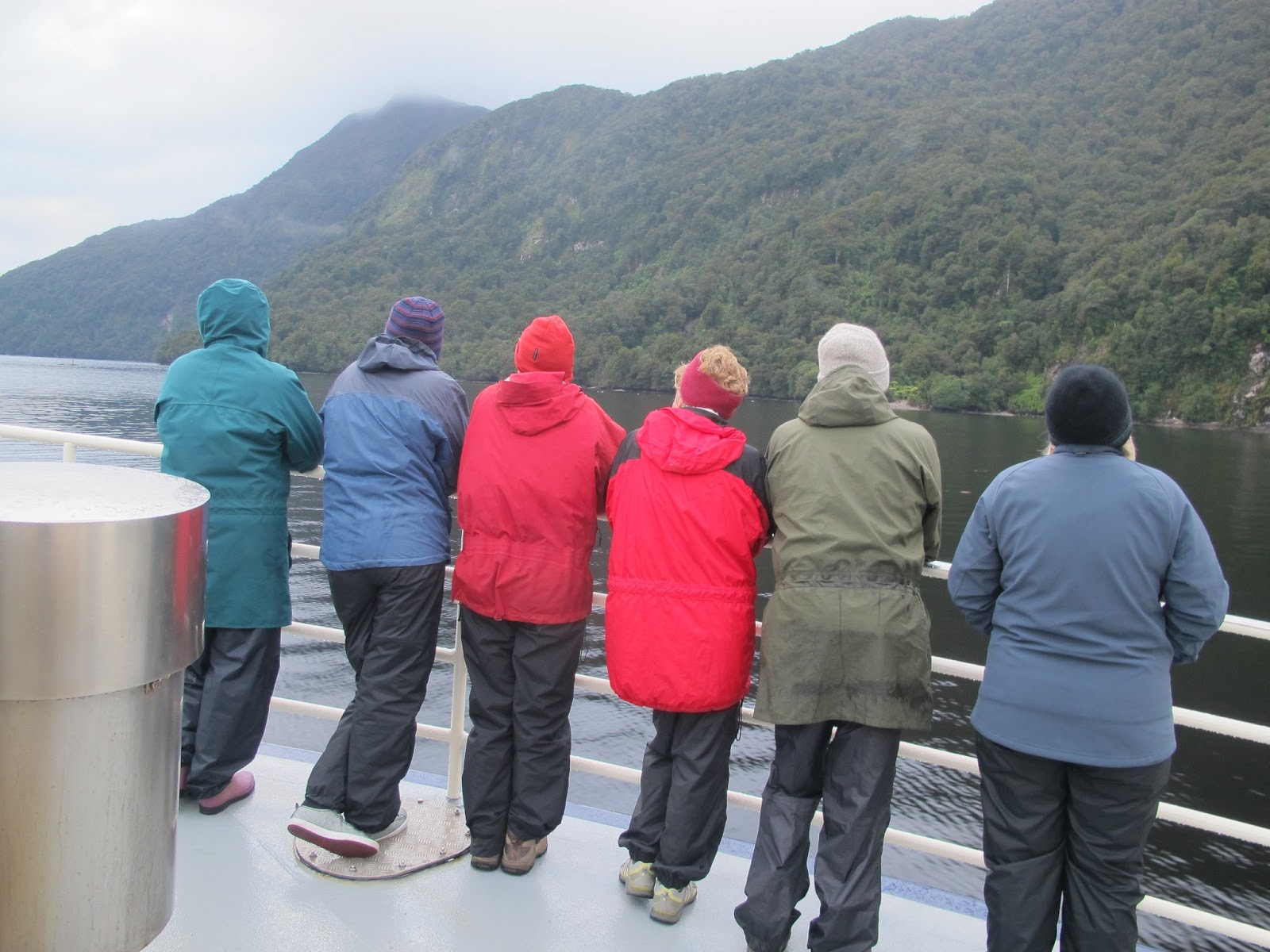
Back Views!

Hanna, Lyn, Sue, John, Neil, Alan, Marg & Kay
|
 |
Seals, Dusky Sound
Marg in her kayak
|
 |
| John after his Dusky Sound "swim" |
 |
| Richard Henry's kiwi pen, Pigeon Island |
 |
| Bartered Crayfish for lunch |
 |
Waterfall, Acheron Channel |
 |
| At sea to Doubtful Sound |
 |
| Doubtful Sound Sunset |
 |
Crooked Arm, Doubtful Sound |

Tuesday, 16 April 2013
Booking a South American trip
Independent travel to South America
Throughout most of the South America, Spanish is the spoken
language and English speakers are very much in the minority. This could have
made travel difficult but despite having a vocabulary of just a few Spanish
words we had no problems at all in organising our trip, getting around once we
had arrived, buying food or gifts, or generally feeling at ease.
Travellers have three different ways to plan travel. Many prefer the security of a tour with
pre-arranged accommodation, transfers and tourist site visits. Others,
especially young travellers, book their flights before they leave home and then
make all their other arrangements after they arrive at a destination country.
We took the third option, and made most of our travel and accommodation
bookings independently prior to departure, leaving most of our time clear to do
as we wished after our arrival.
By travelling independently we had the choice of deciding
how long to stay in each area or town, what type of accommodation to use in
each of those places and whether to fly between towns, or travel overland. We
still had the option of using local tour agencies for short tours of local
attractions, such as a two day tour from Arequipa in Peru to see the condors in
the Colca Canyon. This Colca trip also gave us the choice of travelling on a
bus with many others, or paying more and travelling with just a few others by
car with a guide and driver. We opted for the latter, and ended up as the sole
travellers which allowed our guide to tailor everything to our requirements.
South America is a fascinating continent that offers a
relatively inexpensive destination to stay and travel through. Thanks to the
Internet it is an easy place in which to make independent travel arrangements
before leaving home. We looked for quieter hotels so we could sleep well and
enjoy each day of our trip, and places that were close to the tourist sites. We
decided against long treks such as hiking the Inca Trail which, despite being
reasonably fit, we would have found very testing in the high altitudes.
So how did we do it? Planning a trip for us is half the fun,
and we started thinking about which places to visit about six months before
leaving, raiding the local library of as many tour guides as we could find to
read about possible destinations. This also helped us to choose which guide
books to buy and take with us on our trip. (To reduce the weight in our bags, we
ripped pages out of the books we bought). We chose the Lonely Planet guides to
buy. The Internet provided a great deal of information, including the chance to peek at
where the various tour companies visit as they are likely to centre on the main
tourist attractions.
Early bookings meant lower prices, and certainly a greater
chance of obtaining a first choice of accommodation, so it was important for us
to have plenty of time to decide where to go and what to see.
Our eventual choice was to stay for several days in places
such as Arequipa and Cusco in Peru, Iguazu Falls on the Brazil/Argentine border
and then nearly a week in Buenos Aires, rather than keep on the move every day
or so. So while we would have liked to explore the Lake Titicaca region in
Peru, travel to La Paz in Bolivia, the Galapagos Islands and parts of the
Amazon, time constraints meant that we had to drop those plans. Apart from an
overnight stay to make a flight connection we decided to avoid Peru’s main city
of Lima altogether because of its size. As a couple we prefer to explore
locations on foot as much as we can, which helped in deciding which towns and
cities to visit.
Five months prior to travel we made our flight bookings. We looked
at various airline websites and found that LAN had a South American Airpass
that we could use, providing we travelled to the continent on a LAN flight. This
saved hundreds of dollars on airfares. When it came to actually booking the
flights however, we found in this case it was cheaper to use a travel agent
rather than directly with the airline. (For some reason the quoted price on the
LAN website for the return flight from Auckland to Santiago in Chile fluctuated
greatly from day to day). While we have used an on-line travel agent (Expedia) in the past, our eight separate
flights proved too much for their search engine so our local United travel agency made the flight bookings
for us, along with a couple of airport hotels where flight connections times
required an overnight stay.
Once the flights were in place we made the rest of the
advance bookings. For us these included all our accommodation, two day-long bus
trips in Peru, the tour to see the condors, and rail and entrance fees to Machu
Picchu where their website states that they limit visitor numbers each day. Travellers’
blogs on the Internet provided plenty of advice on what to see and how to
arrange things. We sought hotels that were within easy walking distance of the
main centre, while offering a quiet place to sleep and also were within our
price range. Travellers reported that many of the cheaper hotels and hostals in
Peru sometimes didn’t have hot water for showers, so we avoided those places.
Traveller ratings and comments on various hotels and
apartments on the Trip Advisor website proved very accurate. The comments allowed
us to know in advance that while our inexpensive Arequipa hotel served a rather
skimpy breakfast, it did have a great garden for those afternoon siestas, and
that it was relatively quiet and just a ten minute walk from the central plaza.
Similarly while the hotel we moved to on the Argentine side of the Iguazu Falls
was well priced and had a lovely setting completely enclosed by jungle, we knew
that they charged outrageous amounts for bottled water. In typical kiwi fashion we managed to
circumvent that by buying our water elsewhere at about a tenth of the cost.
We decided have a real splurge for one night at a hotel
within the Brazilian National Park at the Iguazu Falls, which gave us a chance
to wander along the paths next to the falls before the park gates opened in the
morning. Then to balance our budget we found an excellent low cost central
apartment for our six night Buenos Aires stay. Apartment living gave us the
opportunity to live in a 1920s building in the centre of the downtown area and
the freedom to decide whether to self-cater or eat out.
We also found that we could get really good deals by booking
the “luxury” rooms in cheaper hotels. We stayed for six nights in a huge three
room suite in a 3 star hotel in Cusco, Peru, for much less than the cost of an
ordinary room in a 4 star hotel elsewhere in the city.
A few minutes spent on the Internet showed that sometimes it
was cheaper to make bookings directly with a hotel, but alternatively on other
occasions Expedia offered the best
prices, so we booked accordingly. One unusual aspect of travel in Peru is that
many of the hotels do not take credit cards, and so even when bookings are made
through a travel agency, no actual money changes hands until payment is made in
local currency on arrival at the hotel. Fortunately ATM machines, and places
where US dollars can be easily changed at good rates to Peruvian soles, are
found everywhere in the major centres in Peru.
As the accommodation bookings had been made four or five
months prior to travel, and we wanted to make sure that we were still expected
on arrival, we sent an email to all of the hotels a couple of weeks prior to
travel confirming our bookings. All responded, most of them offering to arrange
a taxi to transfer us from the airport or bus station when we arrived.
Some parts of the trip, such as the means of travel across
the border at Iguazu Falls and between Cusco and the village of Ollantaytambo
in Peru, where we spent two lovely days either side of our trip to Machu Picchu,
we did not arrange until we had arrived at our local hotel. However we were
fully aware of the various options, and the costs, thanks to Internet searches
prior to travel.
Before we left home, we had expected to use some of the
local half or full day tours on offer in some of the cities we visited, but
instead found that it was generally easier to visit the places on foot and then
use an internal guide to show us around places such as the centuries old Santa
Catalina convent in Arequipa . Similarly, for less than the cost of an
organised day tour, through our Cusco hotel we hired a taxi to take us from
Cusco to Ollantaytambo, stopping for two or three hours in Pisac to visit the
Inca ruins, travel through the market and have lunch.
On all of the sites we visited, as we were not on an
organised tour we could decide how long to stay. Most of the Inca sites in Peru
are built on fairly steep hillsides which, coupled with the high altitudes,
made clambering through the ruins quite exhausting at times, so we were able to
rest on ancient rocks and catch our breath while enjoying the views, and gaze
at the large groups of guided tourists being rushed through the monuments. The
same applied to our walking trips through the towns. We were free to sit in the
plaza and do a spot of people watching, wander through the streets and see the
local markets, or visit churches or museums as we wished.
Although we were travelling independently we were still able
to meet fellow travellers at breakfast and at other places where tourists
tended to congregate, so that ideas could be exchanged. One such encounter gave
us the name of a good guide, Edwin, to seek out when we visited the Pisac
ruins.
As we had no group constraints about our plans for each day we
had the ability to change them as we travelled. My wife Lyn had some trouble
with altitude sickness in Peru, so we were able to take things a little easy in
the high altitudes without the worry of possibly inconveniencing other
travellers.
Before leaving New Zealand we had printed off the names,
street addresses and phone numbers of all the places where we were staying that
proved useful in helping taxi drivers decipher our mangled attempts at Spanish.
Despite being the same distance from New Zealand and North
America, and not much further from New Zealand as most of Asia, relatively few
New Zealanders tend to visit South America. While potential language
difficulties may put some people off, they caused us no problems. Travel in
South America exceeded our expectations and by organising our own trip, we also
spent about half of price of many escorted tours.
John and Lyn Potter
paid for their own travel to South America.
 |
| Colca Canyon |
 |
| Beef Restaurant Buenos Aires |
 |
| Arequipa Convent |
 |
| Dog Walker, Buenos Aires |
 |
| Iguazu Falls |
 |
| John & Lyn, Puerto Iguazu |
 |
| Machu Picchu |
 |
| Peruvian women with lambs |
Monday, 15 April 2013
Hue Vietnam March 2013 Photographs

The Flag at the Hue Citadel
The following photographs are from inside the citadel


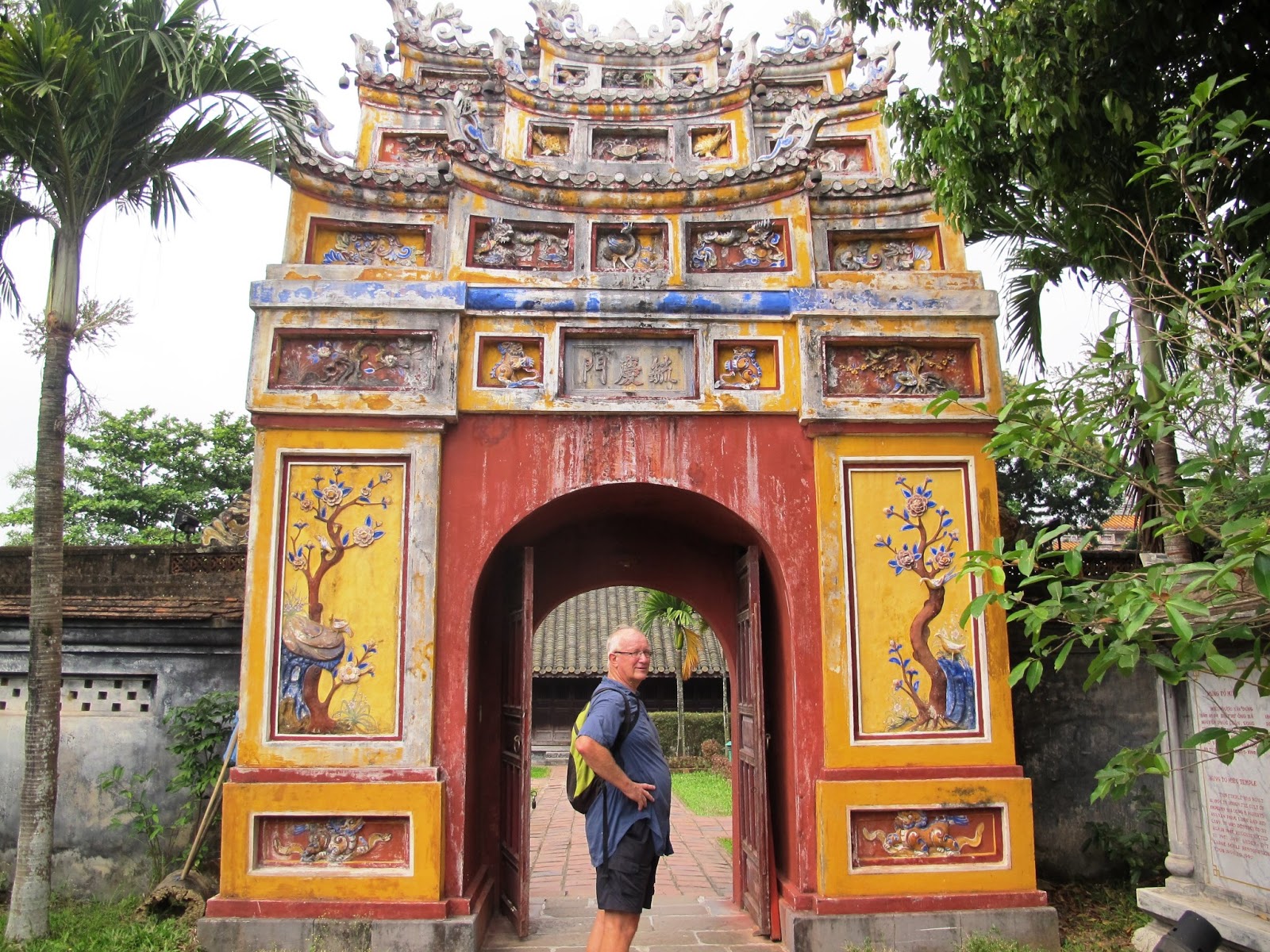


American War Tanks

Perfume River

Perfume River Bridge

Tourist Boat

Thien Mu Pagoda, Hue

From Thien Mu Pagoda

Thien Ma Pagoda

Dragon Fruit

Markets


Romantic Room Swan Towels

Seeing All Fish in the Romantic Room
Subscribe to:
Posts (Atom)